
Holding Space for Emotional Healing: A Beginner’s Guide
The Healing Power of Holding Space
Published: 30 April 2025
Updated: 13 December 2025
When someone you love is hurting, it’s easy to feel unsure, awkward, or afraid of saying the wrong thing. In moments like these, holding space can bring deep comfort, calm, and connection.
In this blog, you’ll learn what holding space really means, why it matters, and how simple actions can help someone feel safe, seen, and supported. If you want to show up with more compassion and confidence — this guide will gently walk you through it.
How to Be There for Someone
Have you ever heard the term ‘holding space’ and wondered what it means? You can kind of guess, but you’re not really sure? By the end of this article, you will know what holding space means, and how to hold space for someone, which is a great way to support loved ones. In addition to holding space for other people, you can also hold space for yourself. (We explain how the term ‘holding space’ came into popular culture later on.)
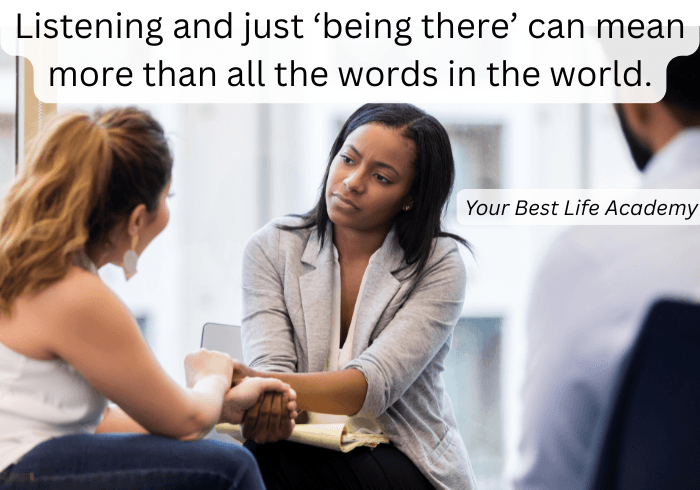
Have you ever had a friend sit with you when you were upset — not trying to fix anything, not judging you, just being there? That’s holding space. Holding space is being present for others (and yourself), and creating a safe space — it’s offering emotional healing support, just by being there, and being present.
It’s a beautiful, powerful gift we can offer each other. And the best part is that it’s free, and anyone can do it. It can also assist with developing deep emotional connections with other people (as detailed in my own experiences in this article).
What Does ‘Holding Space’ Mean?
Holding space means being there for someone with love and kindness.
It’s about making a safe and gentle place where people can share their thoughts and feelings, or just be quiet — without fear of judgment, advice, or pressure. Holding space is about being a good listener, and offering emotional healing support.
When you hold space for someone, you’re saying — ‘I’m here. You’re safe. Take your time.’
It’s simple, but it’s not always easy. It asks us to slow down, to listen deeply, and to let go of the urge to fix, or change things — which is not always easy, in our current culture.
I remember decades ago, when I was living in England, a friend thanked me for being there for him over the period when his Mum was ill, and passed away. I was a little confused, saying ‘But I didn’t do anything.’ He replied that it was my presence, my ‘being there’, and listening to him talk about his feelings (giving him the space to think and feel) – and that that was enough, and exactly what he needed at the time.
Another example of holding space happened this morning (13 December 2025). I was out for a walk, when a little boy crashed his bicycle into the railing, hurting his forehead a little way ahead. The father was on the phone calling an ambulance, while trying to stop the bleeding on the little boy, as another son looked on. I stopped, and did what I could. And yes, I tried to help with directions and a few others things, but it was mainly just being there - another adult holding space for them, while he did whatever he could. I was able to assist with others who stopped by, one kindly giving us her water bottle (which the little boy later drank), but mostly just holding space for the Dad - so he could focus on the phone calls (the ambulance, and his wife), while also stopping the bleeding of his son. I took all the distractions away, and reassured the other son (even though I don't think he was that upset), allowing the Dad the space to focus on the important things. So while it mostly felt like I was just standing there, in the sun, it was actually holding space (which I realised when I got home, and had a think about it). He was grateful, and thanked me at the end. Again, I was mostly just 'there', however it freed up his energy, and my presence give him a little reassurance.
Why Is Holding Space So Important?
When someone is going through a tough time, they don’t always need advice or solutions. Most often, they just need to feel seen, heard, and loved.
As Oprah Winfrey shared in the finale of The Oprah Winfrey Show 'I've talked to nearly 30,000 people on this show, and all 30,000 had one thing in common: They all wanted validation.'
Holding space gives people the chance to:
Speak their truth without fear
Feel their feelings fully
Find their own answers in their own time
It can also build deep trust and connection between people.
When you hold space for someone, you’re showing them they are worthy exactly as they are.
Where is Holding Space Used?
Holding space can be used anywhere. Basically, whenever there is someone who needs some quiet support. This could be a colleague at work, a family member or friend going through a hard time, or someone in a hospital/nursing home/aged care facility who needs a little love, care, and attention.
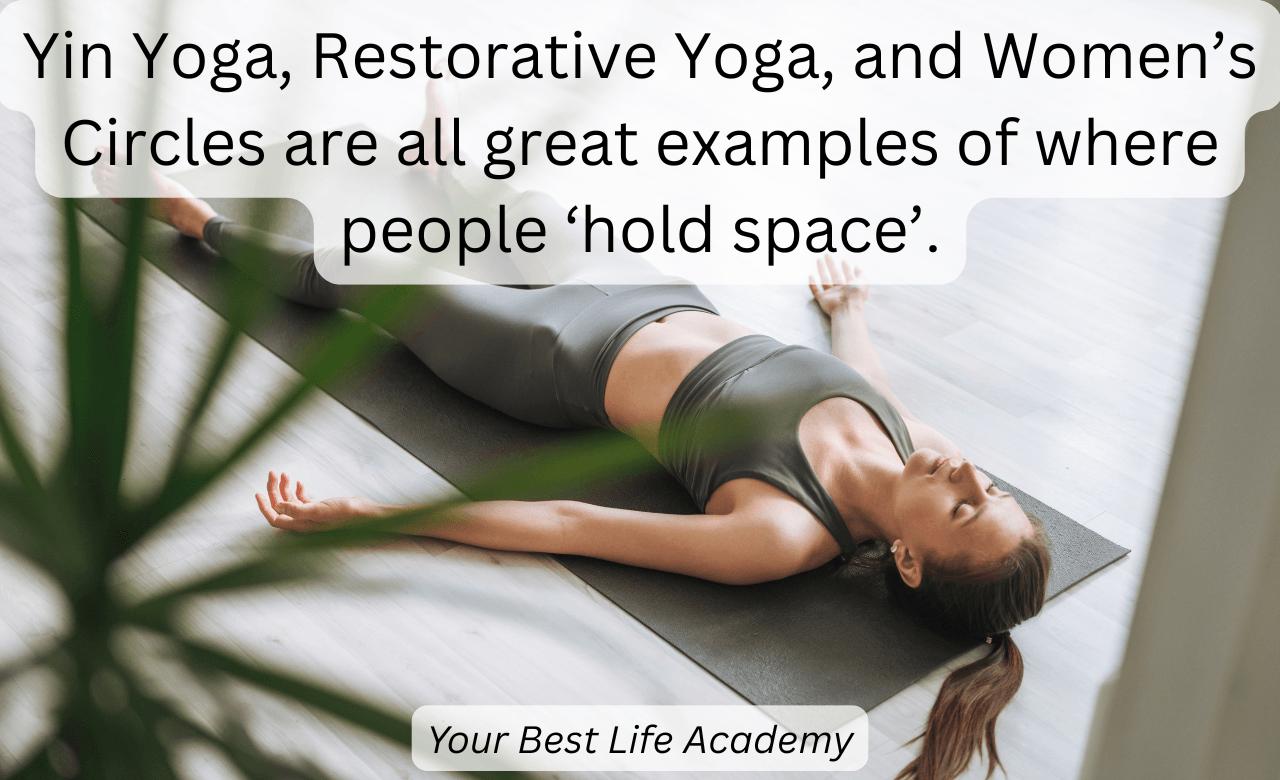
My yoga teacher trainings all spoke about ‘holding space’. Yoga teachers are taught that we hold space for our students. We do this by allowing them the time and space to be themselves, to leave their ‘stuff’ at the door, and spend this time purely focused on themselves – their own mind, body, and soul - without other obligations or pressures getting in the way. We do the thinking for them, in relation to the class, and they are free to just 'be', with the space and time to let go. This is especially true for Yin and Restorative Yoga, which are slower, gentler, and quieter yoga classes, and usually have quiet time for reflection. Sometimes there is a theme, and/or questions that may encourage participants to reflect on something specific – and while this is optional, it allows people the time and space to reflect - without obligation, advice, or questions.
Yoga gives students a chance to be in their own space, without advice (other than yoga instruction) or questions or emotional obligations. We are there for them if they need to talk at the end (within reason, and only up to our own training and capacity). (Yoga teachers can also refer students to trained professionals if appropriate.)
Holding space is also a cornerstone of women’s circles (which were a major part of ancient/indigenous communities). The intention of women’s circle is to allow each woman present to speak from their heart, uninterrupted, in a safe and respectful space. While often others in the circle want to offer advice, or suggestions, or a different perspective, the intention of the women’s circle is listen deeply, and to allow the speaker to have their own time, their own space, and their own thoughts, without us interrupting them with our own views. The speaker has our deep, respectful, listening attention– so at the end, they feel seen, heard, and validated in a way that is not often seen in our current culture. And as Oprah shared, at the end of the day, everyone wants to be seen, heard, and validated.
How to Hold Space for Someone
You don’t need special skills — just an open heart, and a little practice. We’ve outlined some simple ways to hold space below.
1. Listen More Than You Talk
Let the other person speak without interrupting, or steering the conversation.
Sometimes, the best thing you can say is simply, ‘I’m listening.’
2. Offer Love, Not Solutions
It can be tempting to jump in with advice — but unless they ask, it’s better to simply be present.
Trust that they will find their way. Your love, presence, and compassionate listening are enough.
3. Be Patient
Some people need time to open up. Some need silence. Some need tears.
There’s no rush. Let things unfold naturally, in their own time, in their own way – this helps with deep emotional connection, as they don’t feel rushed, or pressured with advice on what they should do. It allows trust to develop.
4. Keep Your Judgments to Yourself
Everyone has their own unique journey, with their own values, beliefs, experiences, and ideas.
Even if you don’t understand their choices, respect their right to walk their own path. By creating a safe space, being present, and listening with compassion (and without judgement), you will provide emotional healing support, and deepen the emotional connection and trust between you. People are much more likely to open up and trust if there are no judgements or advice offered, and they are given the time and space to think and speak.
5. Check In Gently
You can say things like:
‘How can I support you right now?’
‘Would you like me to listen, or would you like advice?’
‘Take your time. I’m here.’
This mindful communication gives them the freedom to tell you what they would like at that time, supporting loved ones in their time of need.
A Personal Example of Someone Holding Space for Me
One morning at work, I had a moment when my Dad’s terminal illness was getting to me. I was so upset, I left work, and ran over the road with my phone to call a friend who was going through the same thing with his own Dad. I called him, and he answered, saying that he knew he had to take the call, as I never called him during work hours, so he knew it must be something important.
I pretty much just let it all out – ranting and raving, crying, just upset and angry – while he listened, said Uh-hu, I get it, I understand, etc. His empathetic listening was exactly what I needed. There was nothing either of us could do – there was no ‘fix’. He just listened, and empathised, and held space for me. His presence, just being there for me, and listening, was exactly what I needed at that time. It allowed me the space and time and freedom to let go, to get the emotions out - and by the end, I felt cleansed, heard, and validated. Eventually, after I’d let all the emotion out, and talked it out with my friend, I calmed down, and went back to work. I am forever grateful to my wonderful friend, and for the love, care, and attention that he showed me that day – holding space for me in an amazing way, when I most needed it.
I am so grateful, and it is one of my most cherished memories of my late friend.
How to Hold Space for Yourself, Too
Holding space isn’t just for others — it’s something we can give ourselves, too.
It means allowing yourself to feel your own feelings without shame, so they’re not bottled up where they build up and grow. If you need some help to feel your feelings, or manage your feelings, you could try journaling, which can be very helpful in clarifying what you’re feeling, and why.
I remember once when I was feeling emotional, I wrote in a journal as fast as I could, letting everything out, in a scrawling, messy, repeating mess. After I’d gotten some of the feelings down, I wrote a bit more ‘normally’, and kept going. By not monitoring or judging what I wrote, or how I felt, I discovered some underlying beliefs that I hadn’t realised were there, or were driving the emotions. I then considered the beliefs, and adjusted them, so they reflected more of who I wanted to be. This is one way (free!) to help you hold space for yourself. (We also have more free resources at the end of this article.)
Holding space means being gentle with yourself when you’re struggling (self-healing through our own compassionate presence).
It means trusting that you don’t have to ‘fix’ yourself — you can simply be with yourself, with love — giving yourself the gift of compassionate emotional healing support.
After all, you deserve the same kindness you offer to others.
Where Did the Term ‘Holding Space’ Come From?
The idea of ‘holding space’ has been around for a long time, even though people might not have always used those exact words. Many cultures, spiritual traditions, and healing practices have long spoken about being present with others in a supportive, non-judgmental way.
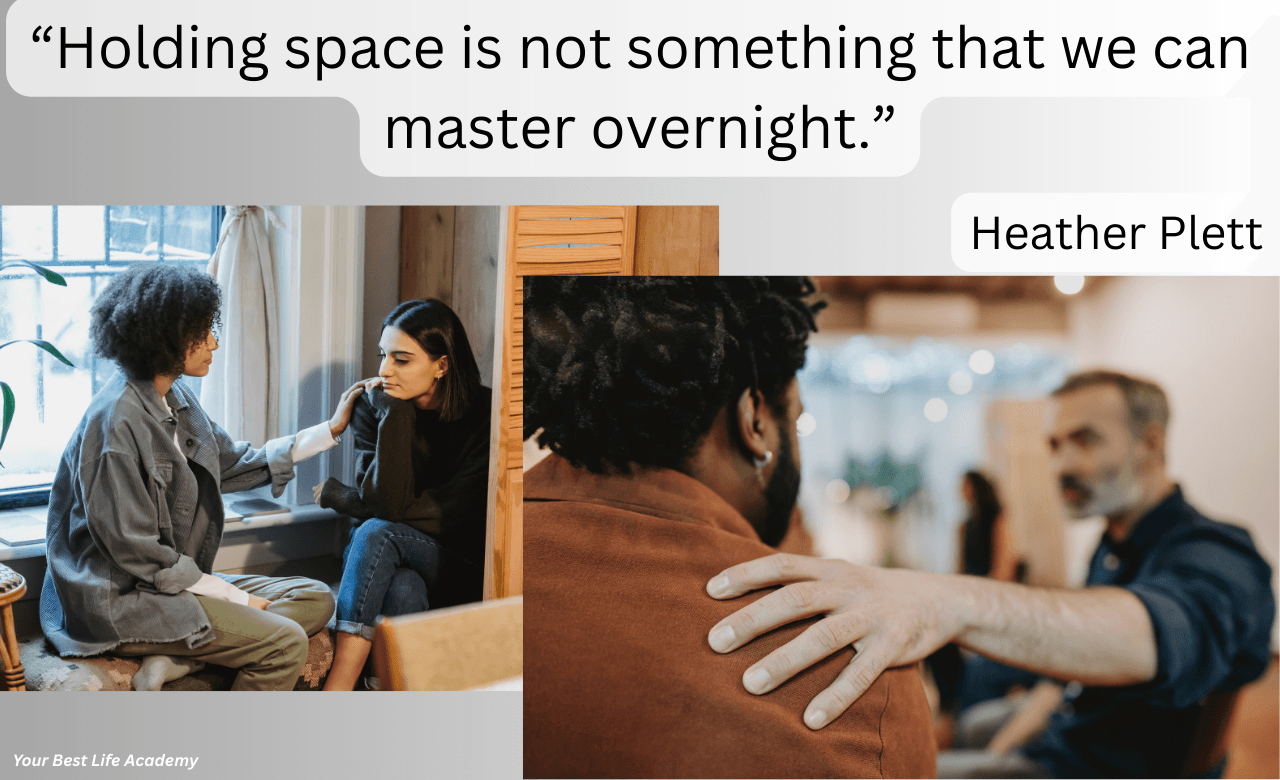
The term ‘holding space’ became more widely known around 2015 when Heather Plett published an article about how a palliative care nurse held space for her and her family while her mother was dying. She shared how powerful it was to have someone there, offering quiet support, without trying to fix, control, or rush their experience.
Her articles (see links below) resonated with people around the world, and since then, the idea of ‘holding space’ has spread into coaching, therapy, education, healthcare, leadership, and everyday life.
Even though the words might be newer, the heart of the practice — being lovingly present for another person — is timeless. And yes, it can take time to get good at it - but the benefits are worth it.
Final Thoughts
Holding space is one of the kindest, most loving things we can do — for others, and for ourselves.
Holding space doesn’t require fancy words, big actions, or any magic solutions — just an open heart, a listening ear, and the willingness to simply be with someone, wherever they are.
In a world that often wants to rush in and ‘fix’ things, holding space is a beautiful way to say ‘You are not alone.’
🙋 Frequently Asked Questions
1. Is holding space the same as giving advice?
No, it's not. When you hold space, you're not giving advice unless the person asks for it. You're mainly offering your presence, understanding, and kindness. They can feel your emotional support through your understanding presence, and that’s enough.
2. Do I have to be completely silent when holding space?
Not necessarily. You can speak if it's helpful, but the focus is on listening more than talking. Short, supportive comments like ‘I'm here’, or ‘Take your time’ can be very powerful. (If you'd like more ideas on what to say, our free download 25 Phrases to Use When Comforting Someone can help.)
3. Can I hold space for someone even if I don't fully understand what they're going through?
Yes, you can. You don’t have to understand everything about their experience. What matters most is your willingness to be there with compassion, and an open heart.
4. How do I know if someone wants me to hold space for them?
You can gently ask. Try saying, ‘Would you like me to just listen?’ or ‘Would it help if I just sit with you?’ Respect their wishes, whether they want to talk, cry, or even sit in silence.
5. Can I hold space for myself too?
Yes, absolutely. Holding space for yourself means allowing yourself to feel what you feel without judgment. It's giving yourself kindness, patience, and love — especially when you're going through a hard time.
📚 Additional Resources
25 Phrases to Use When Holding Space for Someone (Free Cheat Sheet)
If you'd like a little more help in connecting with people, so they feel heard, seen, and validated, our free 7-day Active Listening Challenge can help!
Emotional Balance: Easy Steps for a Calmer You (Blog)
If you would like a free download to help manage emotions, try ‘Managing Your Emotions – Free Checklists & Journal Prompts’.
Want more practical ideas and thought-provoking content on a regular basis? Don’t miss out on all the hints & tips that you can implement over time! Sign up for weekly input to help you uplift your life – one week at a time!
We have also created stand-alone pages in the 7 life segments with all blogs, freebies, and paid products grouped together, so you can easily find and review items of interest to you. Click on the links below to find the areas of most interest to you!
Life Purpose & Best Life - Health & Wellness - Relationships - Abundance - Personal Growth - Peace of Mind - Spirituality & Energy.
📖 References/Further Reading
Disclaimer
This blog post is for informational and inspirational purposes only. It is not a substitute for professional advice, therapy, counseling, or medical care. If you (or someone you know) are experiencing emotional distress or mental health challenges, please seek support from a qualified professional.
Your Best Life Newsletter
Your Weekly Dose of Inspiration to Live Your Best Life!
✔️ Get practical tips to feel happier, healthier, and more fulfilled.
✔️ Discover easy ways to bring more joy and purpose into your life.
✔️ Be the first to know about new blogs, free resources, and special offers.
💌 Join our supportive community today — it's free!
© 2025 Your Best Life Academy